Diff Brokerβ

Every pull request that needs you, on one screen

Understand each one without reading every line, then decide, or hand the legwork to the agent already on your machine.

Free while we build it. If that ever changes, you will hear from us well before it does.

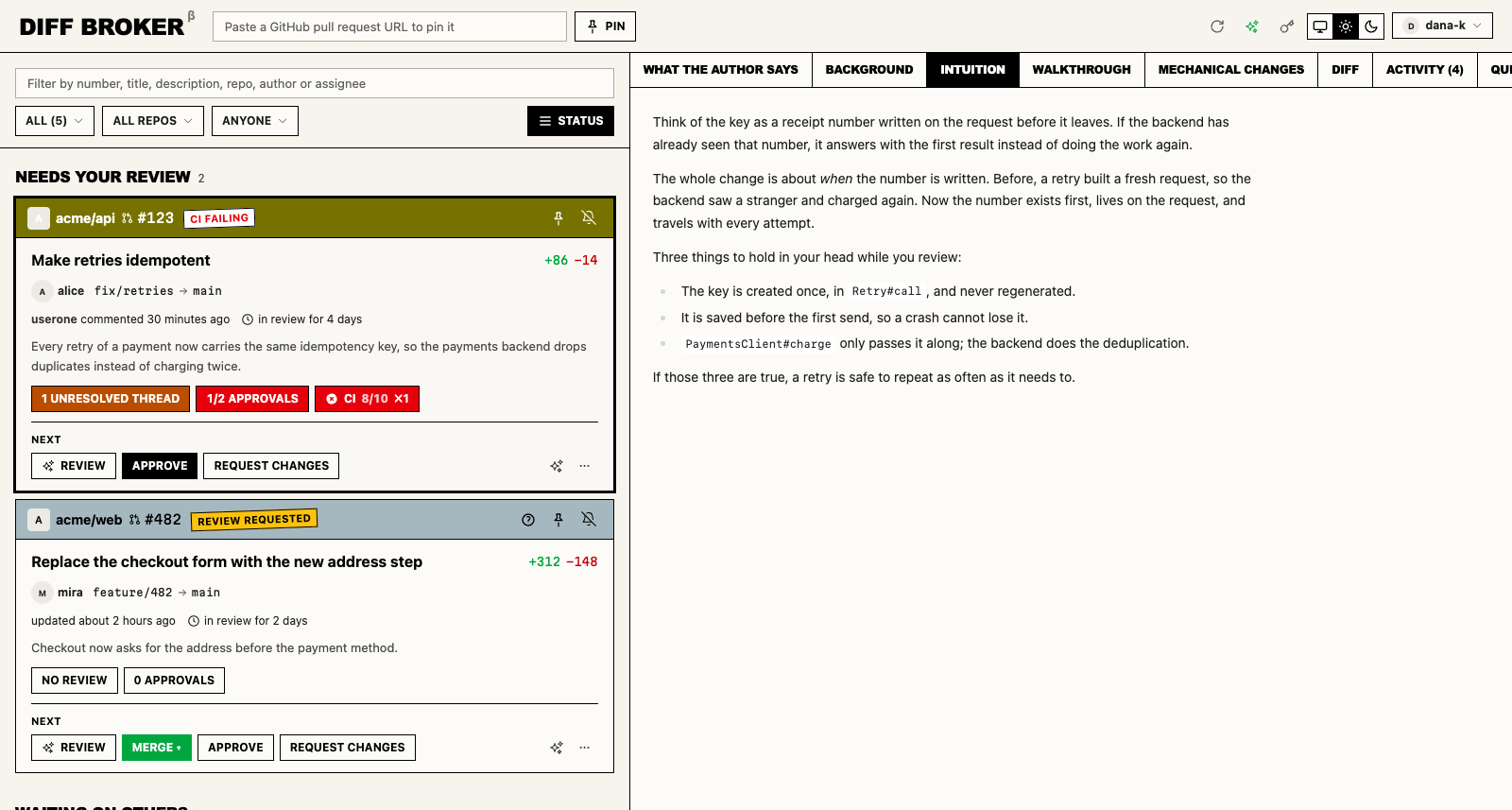
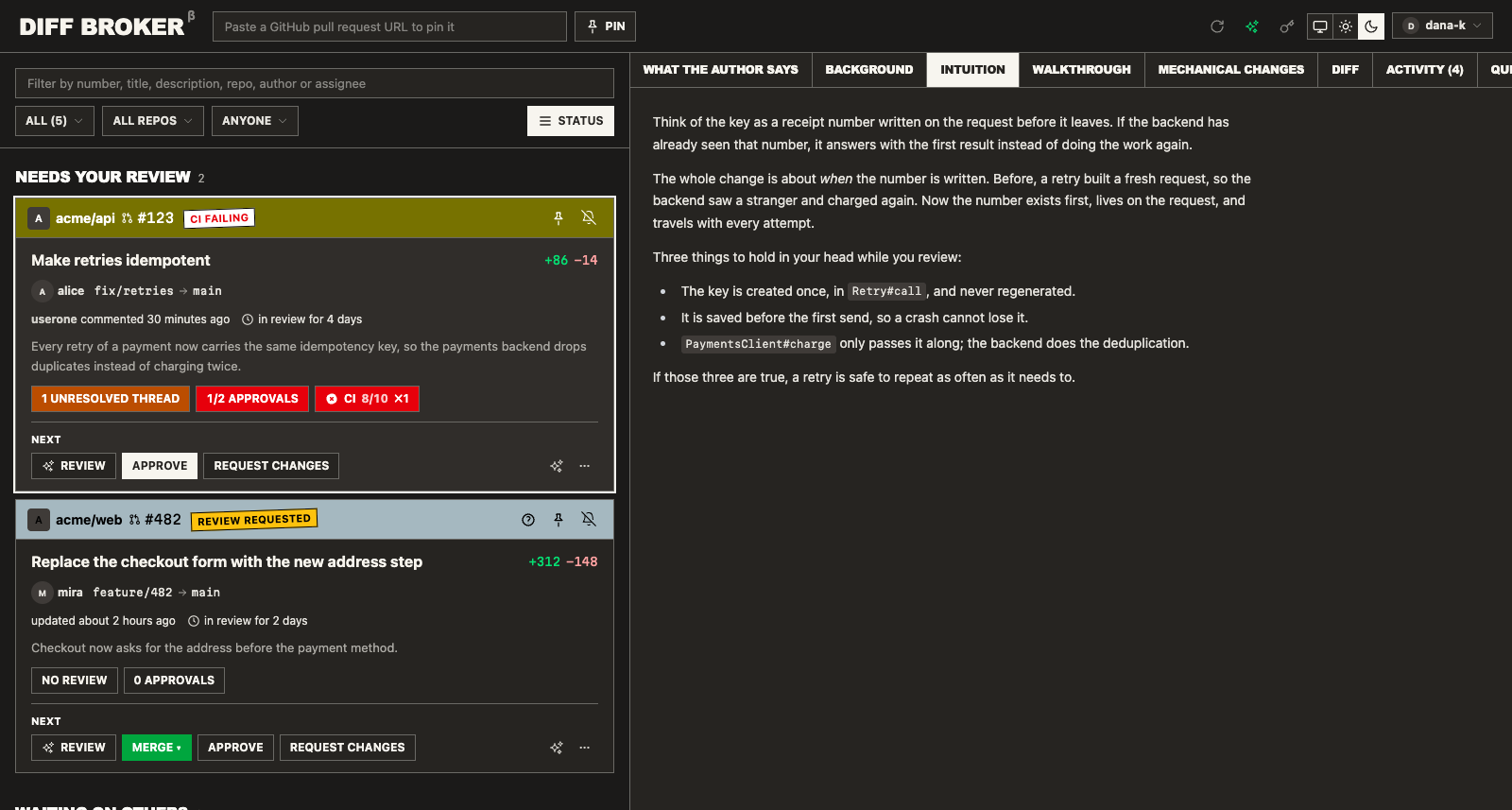
The Diff Broker inbox: pull request cards from three repositories on the left, the unread activity feed on the right. The Diff Broker inbox: pull request cards from three repositories on the left, the unread activity feed on the right.

See what needs you

Every pull request that involves you, from every repository and organization you can reach, syncs once a minute. Each repository keeps its own colour, so you know where you are before you read a word.

Everything that involves you
Review requests, your own pull requests, mentions, and any pull request you pin by pasting its link.
One next action per card
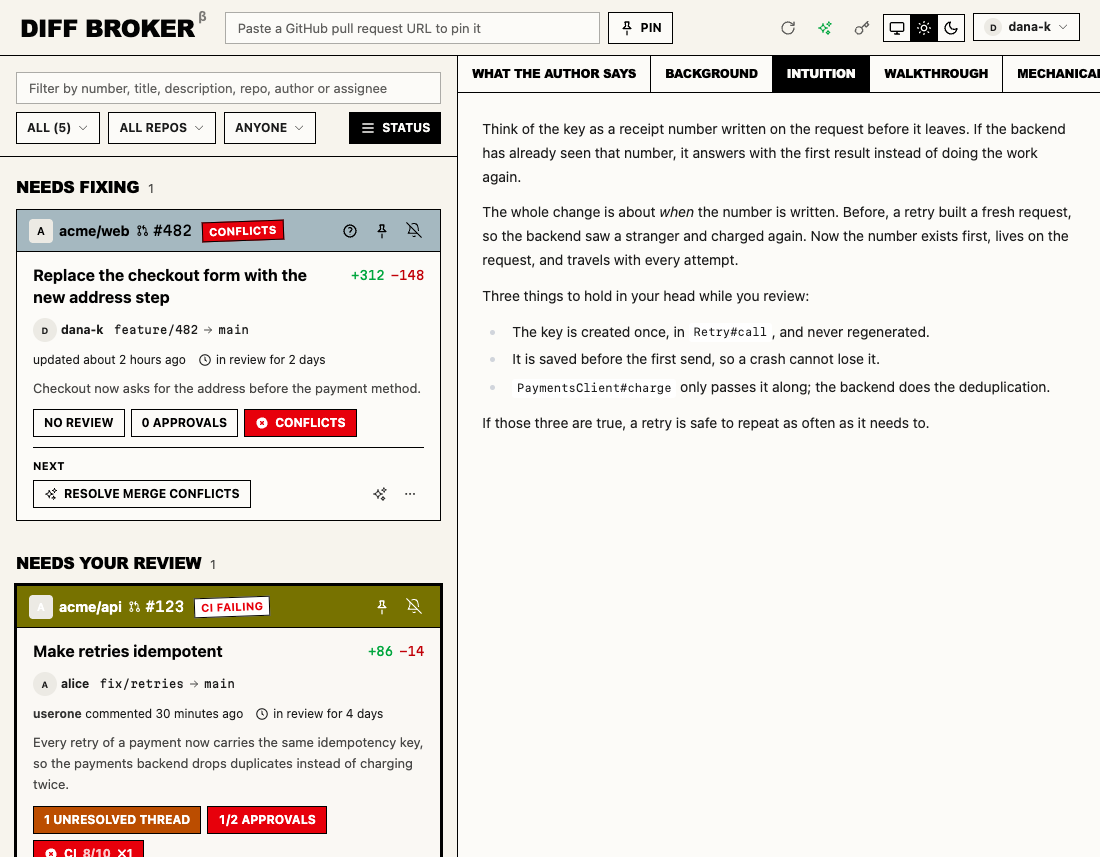
Review, approve, merge, fix CI or resolve conflicts leads the card footer. A yellow sticker marks what is waiting on you.
CI you can read
Required and optional checks are counted apart. Only failing required checks, open threads and conflicts are loud.
Unread, comment by comment
New comments and reviews are tracked per event, and "since you last looked" shows only what changed.
Quiet when you need it
Snooze until a time or until new activity, mute a pull request, mute bots.
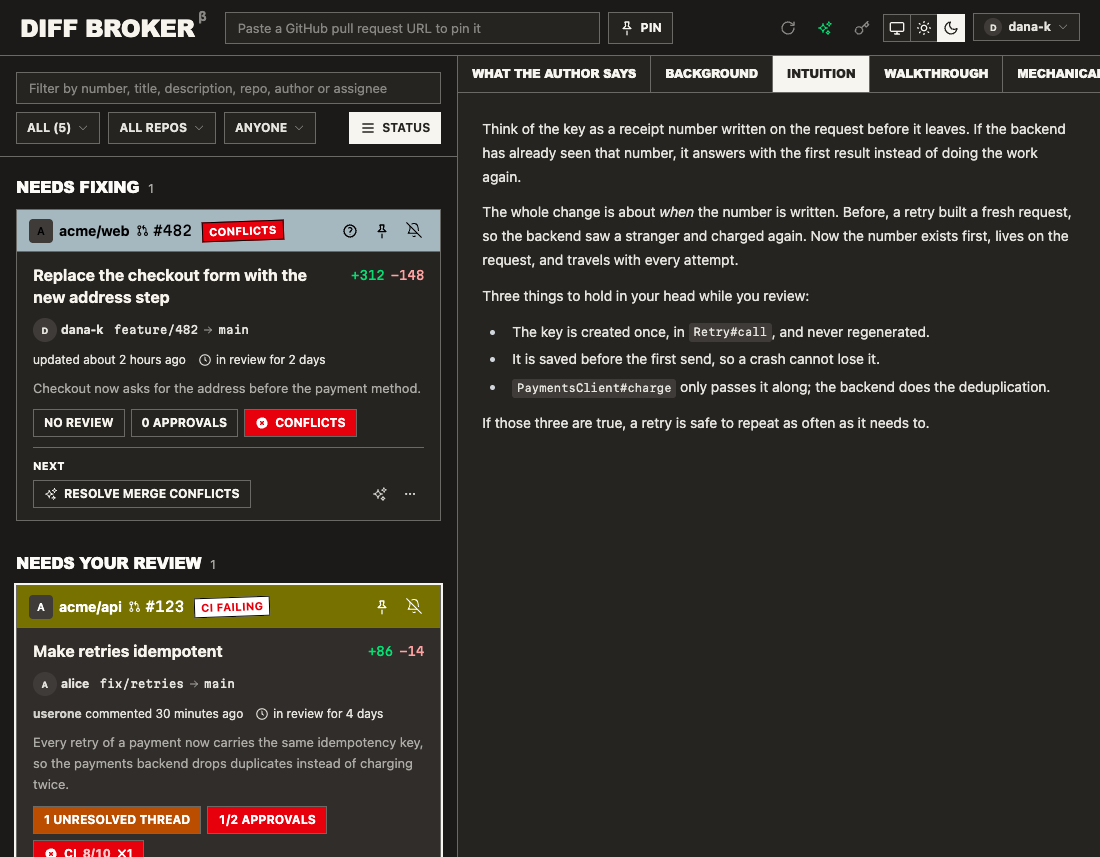
Pull request cards with a repository colour ribbon, a Conflicts sticker, check, approval and thread chips, and the Resolve merge conflicts action. Pull request cards with a repository colour ribbon, a Conflicts sticker, check, approval and thread chips, and the Resolve merge conflicts action.

Understand it in minutes

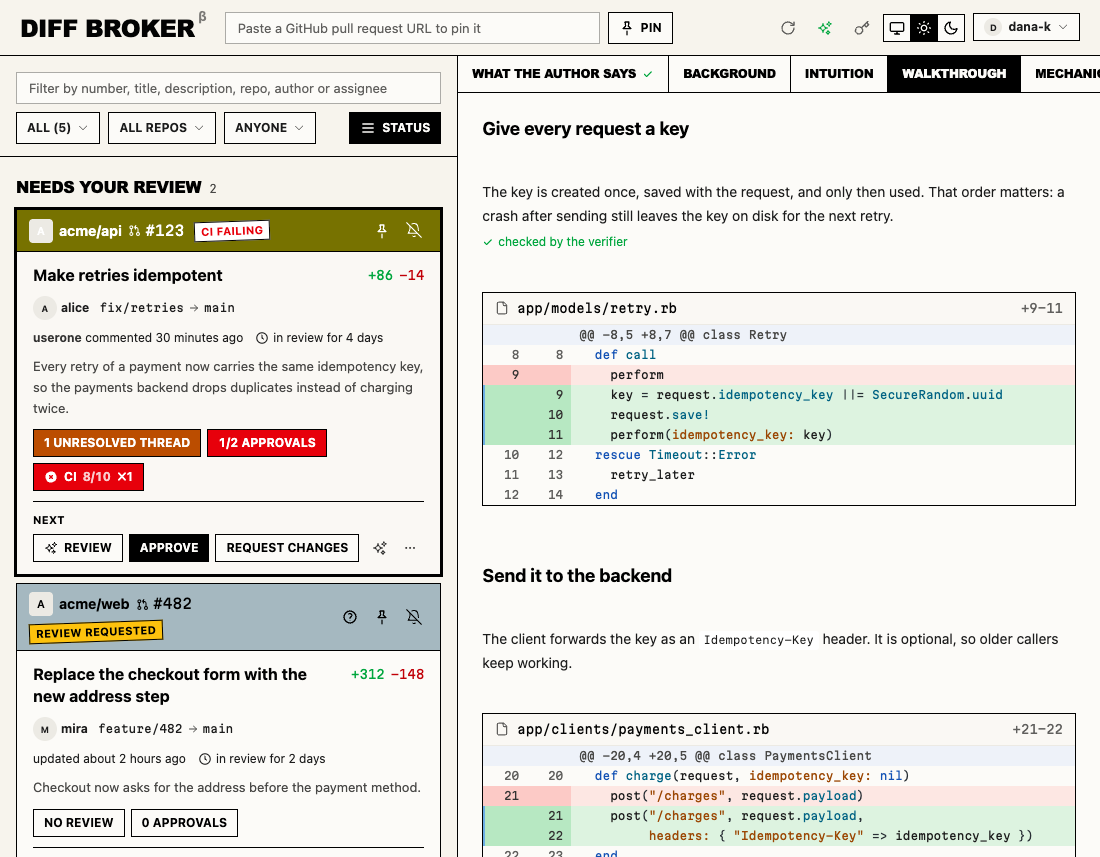
Opening a card opens a lesson, not a wall of diff: what the author says, the background, the intuition, a walkthrough of the real changes, the mechanical edits set aside, the discussion, and a short quiz.

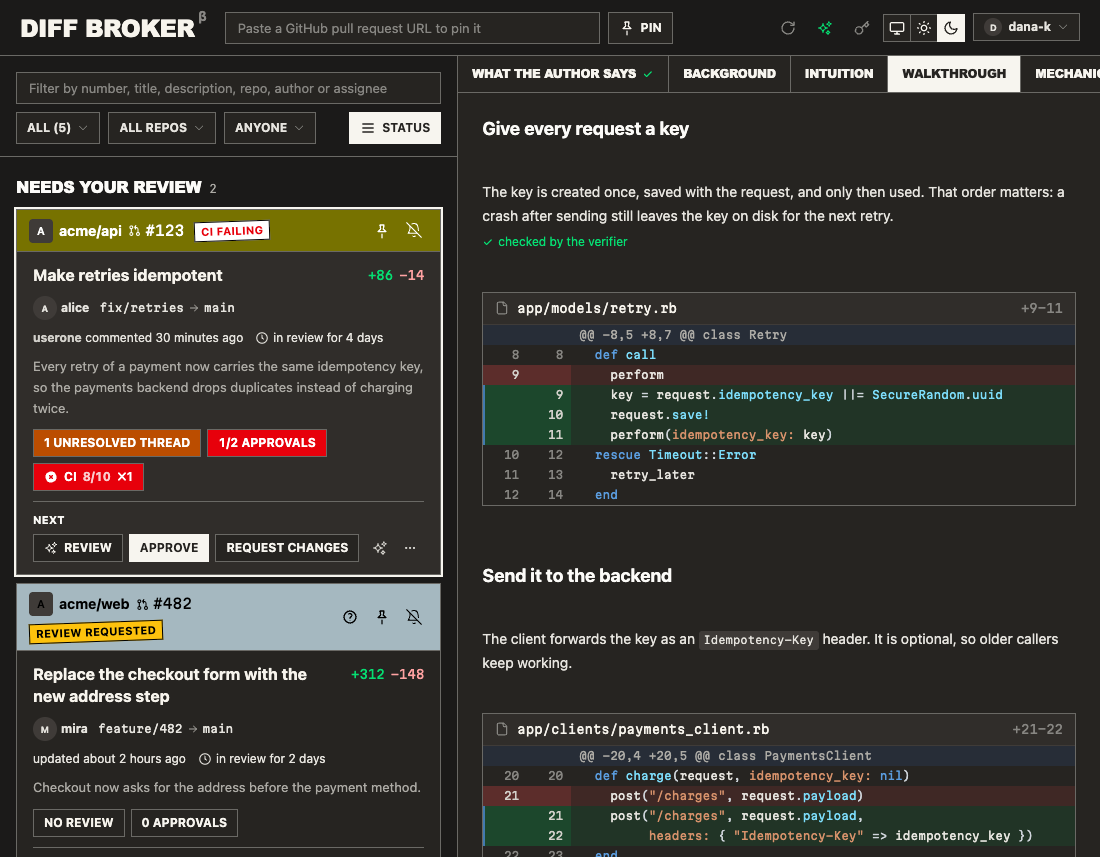
The walkthrough tab: a chapter of prose followed by the real diff hunk it explains. The walkthrough tab: a chapter of prose followed by the real diff hunk it explains.
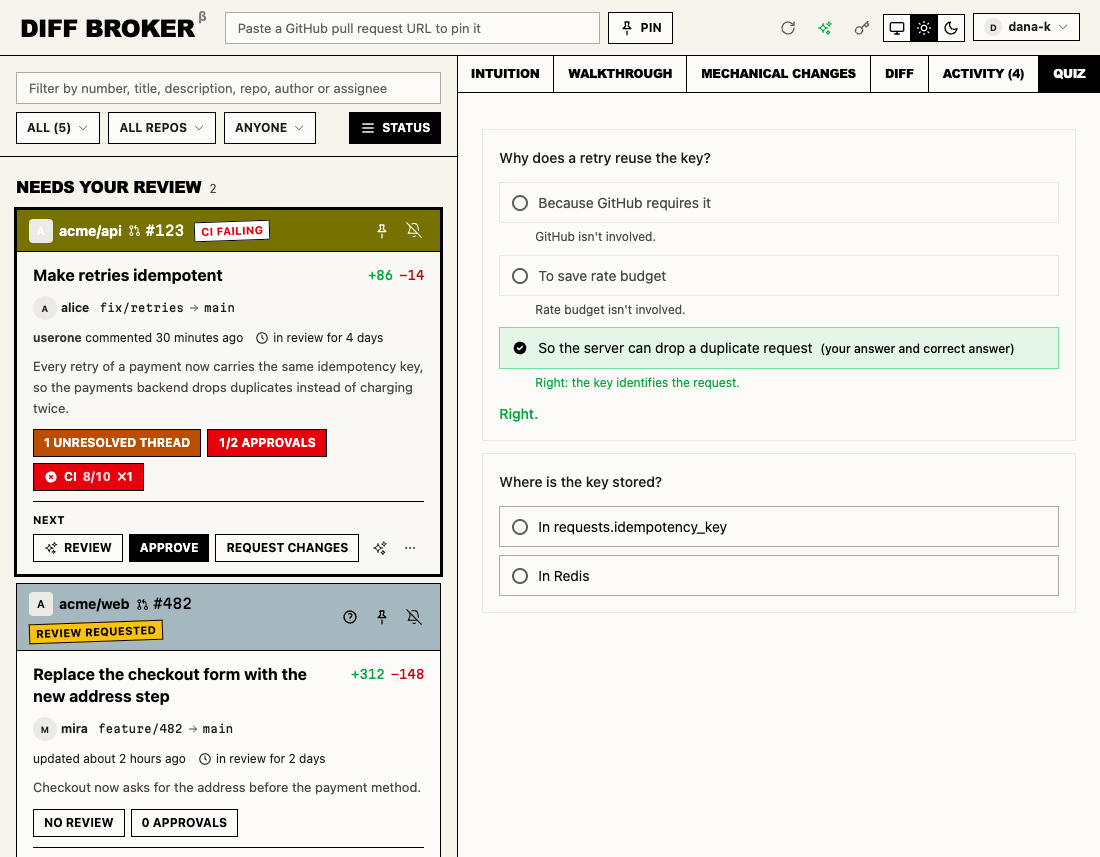
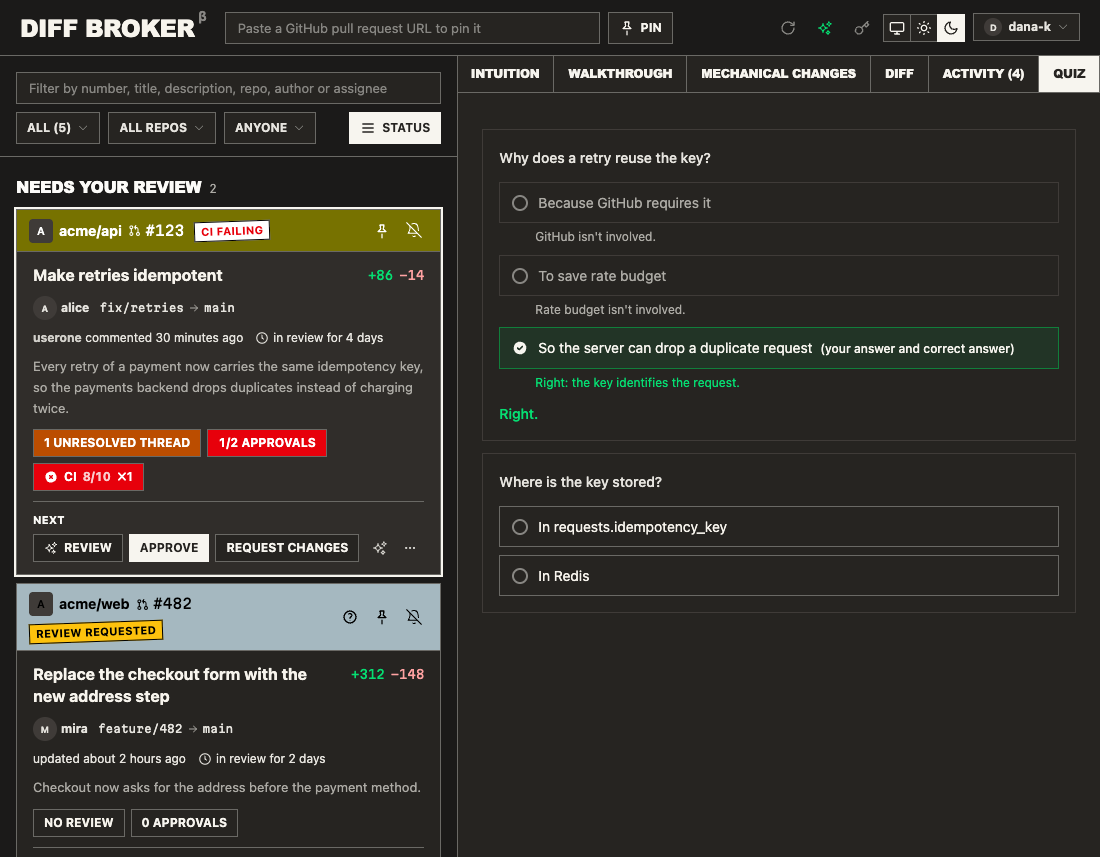
The quiz tab: a multiple-choice question answered correctly, with feedback on every option. The quiz tab: a multiple-choice question answered correctly, with feedback on every option.
Real code, never retyped
Every snippet is a hunk fetched from GitHub. The explanation points at it; it cannot invent it.
Checked before you see it
A separate verifier pass must support every claim in the walkthrough and the quiz, and every hunk must be covered.
A quiz that is yours to take
First-try scoring, pass at 80%. The card shows whether you understood the current version, and when the pull request moves on, it asks again only about what changed.

Act without leaving

Every decision is one click from the card, and the boring parts go to the agent you already run.

Your GitHub, your permissions
Approve, request changes, comment, reply, resolve, merge, re-run failed jobs, update the branch, label, assign, request reviewers. Each write uses your own token, is checked against the pull request's current head, and is logged.
Hand it to your agent
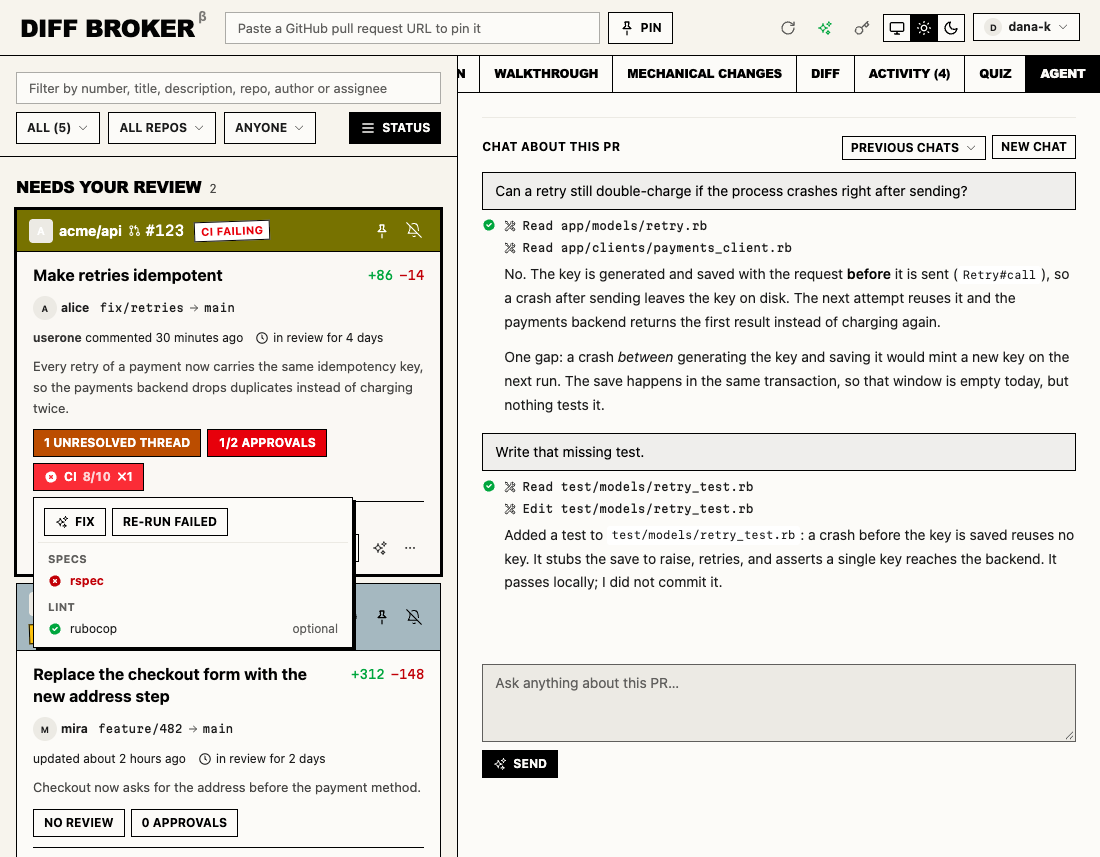
Review, fix failing CI, address review comments, rebase, rewrite a thin description, or ask a question about the pull request in a chat. Runs in the background or in your own terminal.
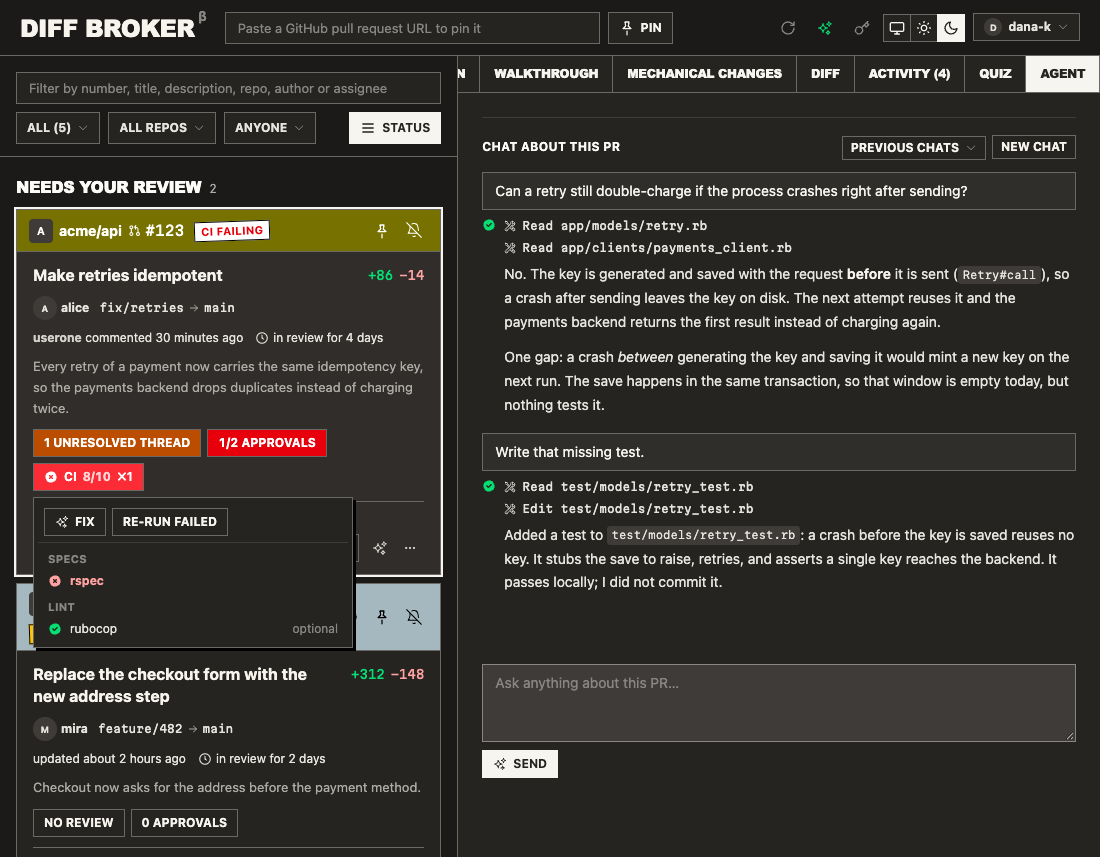
A card's CI menu with Fix and Re-run failed, and the Agent tab with a chat about the pull request. A card's CI menu with Fix and Re-run failed, and the Agent tab with a chat about the pull request.

Bring your own agent

Diff Broker's server never calls an LLM. A small companion runs the Claude Code or Codex you already have, in a separate git worktree, with a token that reaches one pull request and nothing else. Your keys, your quota, your machine.

Forks and pull requests from non-members run neutralized, and anything that publishes or changes code stays in your terminal.

# Install the companion

$ gem install diffbroker

# Pair and start it (paste the code it prints at /devices)

$ diffbroker start

Why it works

Diff Broker is built on a few ideas from people who think hard about working with AI-written code. We took what they found and left the rest.

Understanding is the bottleneck

Agents write code faster than anyone can understand it. Turning a diff into a lesson (background, intuition, then the code) is how people keep up, and it feeds both checking the work and having the next idea.

Source: Geoffrey Litt, "Understanding is the new bottleneck"

Reading is not understanding

Transmitting an explanation does not create understanding, and readers cannot tell when they have not understood. Questions woven into the material fix both, which is why the quiz is part of the pane.

Source: Andy Matuschak, "Why books don't work" ; Quantum Country

Extract code with tools, never retype it

A model that retypes code can invent it. Walkthroughs should pull snippets from the source with tools, so the code you read is the code in the pull request.

Source: Simon Willison, "Linear walkthroughs"

Free today

Diff Broker costs nothing while we build it. If we ever introduce paid plans, we will tell you well before anything changes, and say plainly what is free and what is not.

Open your desk

One sign-in, and the pull requests waiting on you are on one screen within a minute.

Diff Broker asks for the repo scope because it can act on pull requests for you (approve, comment, merge) — only when you click. It also reads org memberships and projects.